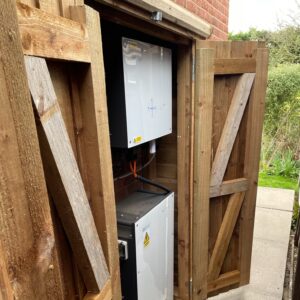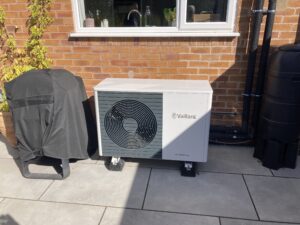
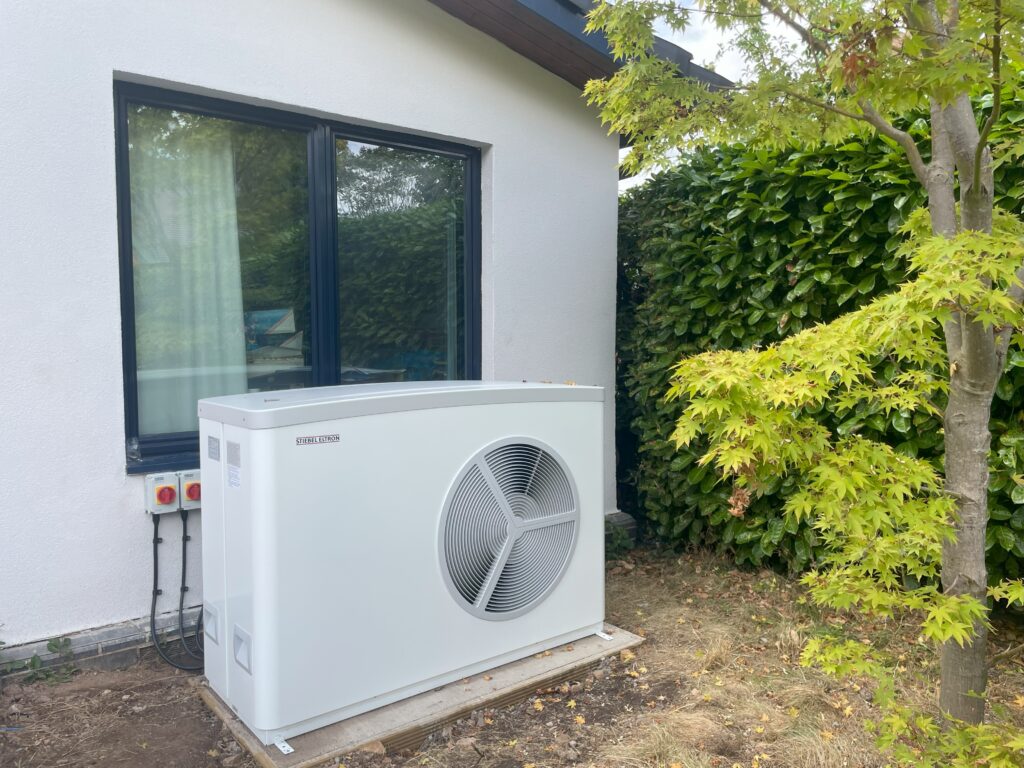
Air Source Heat Pump (ASHP)
Pros
- Highly efficient: An ASHP produces three to four times the amount of heat per unit of electricity used.
- Eco-friendly: ASHPs use electricity to transfer heat from the air outside instead of burning fossil fuels, helping reduce CO₂ emissions.
- Low running costs: Energy bills can be reduced, especially when combined with solar panels and battery storage.
- Government grants available: Many households are eligible for grants to help lower the cost of installation.
- Space-saving: The heat pump unit is stored outside your home, freeing up indoor space.
Cons
- Higher upfront cost: The cost of a new system can be higher than a traditional system, and new radiators may be required for maximum efficiency.
- Electricity tariffs: Running costs can vary depending on your electricity rate. The system becomes more cost-effective when supported by solar panels and battery storage.
- Home upgrades may be needed: Improved insulation, upgraded radiators, or underfloor heating can help optimise performance.
- External unit placement: The outdoor unit may raise concerns about noise, but modern heat pumps are relatively quiet. A sound assessment ensures that noise levels are acceptable for you and your neighbours.
- Lack of familiarity: Some homeowners may initially feel uncertain about warmth levels or system performance.
Traditional Heating Systems
Pros
- Lower initial cost: Cheaper to install compared to an air source heat pump.
- Familiar technology: Easy to use and understand, with well-known controls.
Cons
- Lower efficiency: More energy is wasted compared to a heat pump system.
- Higher carbon emissions: Increases your carbon footprint.
- Fluctuating running costs: Energy bills depend on fossil fuel prices.
- Not sustainable: Relies on non-renewable resources that will eventually be phased out.
Which to Choose? A Summary of the Two Options
Air Source Heat Pumps are currently well-supported by the government’s Boiler Upgrade Scheme (BUS) grant due to their low carbon emissions. If you want to transition to a cleaner, more sustainable energy system, now is an excellent time to make the switch.
Although initial installation and home upgrades may cost more, these changes will reduce heat loss and lower your energy bills long-term.
Traditional systems, on the other hand, offer familiarity and lower upfront costs. However, as the UK moves towards phasing out traditional boilers, spare parts may become harder to find — and energy bills will remain higher over time.
Heat Pump Myths Debunked
“Heat pumps are noisy.”
Modern heat pumps are much quieter than older models. A client in Malvern told us,
“Sometimes I can only tell it’s on by walking past it and feeling the cool air.”
As part of every installation, a sound assessment is carried out to ensure noise levels are acceptable. Plus, you’ll enjoy the peace and quiet of no longer hearing an old boiler inside your home!
“Heat pumps take up loads of space.”
Air source heat pumps are relatively compact and can fit easily into a small space on a typical driveway or alongside a wall. (Ground source heat pumps, however, do require more land.)
“Heat pumps aren’t suitable for older properties.”
Most older homes can be adapted through internal or external insulation so that a heat pump works efficiently. Even many listed buildings have viable solutions.
“Heat pumps don’t make your house feel warm in winter.”
Heat pumps are designed to keep your home at a constant, comfortable temperature. You can still adjust your radiators thermostatically to create a cosy atmosphere on particularly cold days.
“Heat pumps don’t provide hot water.”
If you have a cylinder installed, your heat pump can heat your hot water supply — the amount depends on the cylinder size. Once emptied, the system will reheat the water, which may take a little time.
Need Some Advice?
If you’re unsure whether you can afford the higher initial cost of an air source heat pump, or whether your home can be insulated well enough, get in touch with us at Malvern Solar for some free, no-pressure advice.